Showing posts with label VIJAY PRASHAD. Show all posts

Sunday, June 1, 2014

The Dangerous Compromises of a Harvard Professor

APRIL 07, 2014

Chalo Delhi!

by VIJAY PRASHAD
How is a Harvard Professor of history to makes sense of the grammar of Indian electoral politics? There is the retail end of things, the door-to-door campaigns, the street meetings, the processions through congested streets and the back-door deals cut with this or that power-broker. Harvard Yard might be a den of conspiratorial faculty deal making, but it is a far cry from the hustle and bustle of Indian electioneering. Nonetheless, Gardiner Chair of Oceanic History Sugata Bose is now the Lok Sabha (parliament) candidate for the Trinamul Congress (TMC). He will run to win the Jadavpur constituency in West Bengal. A previous Harvard professor and US Ambassador to India, John Kenneth Galbraith, wrote in 1958 that Indian society is “the world’s greatest example of functioning anarchy.” How is Professor Bose to navigate this chaos?
Professor Bose is no stranger to Jadavpur, the home of one of West Bengal’s most important universities. His mother has been the Member of Parliament for the district three previous times. When he arrived from Cambridge, Massachusetts to take up the cudgels for the TMC, the party workers greeted him with the slogan, Netaji-er gharer chhele ke vote din, vote din (Vote for the boy who is from Netaji’s family). They referred to Bose’s granduncle, Netaji Subhash Chandra Bose, who is a beloved nationalist leader. Netaji, as he is called, oscillated from bourgeois nationalism (he was the president of the Indian National Congress) to socialism (he founded his own Forward Bloc party). The Forward Bloc party is now in the Left Front alliance, the adversary of Professor Bose’s TMC. Sugata Bose and his mother, Krishna Bose, are both authors of books about Netaji, with Sugata Bose’s His Majesty’s Opponent: Subhas Chandra Bose and India’s Struggle for Independence arriving with the imprimatur of Harvard University Press in 2011. Professor Bose is aware of the power of his inheritance. “You elected my mother from here three times,” he says in the middle-class neighbourhood of Garfa, “I’m hoping that you will bless me in the same way.” In his biography of Netaji, Professor Bose sneered at the Congress for being “under dynastic control” of the Nehru-Gandhi family. Nothing so bad when one is advantaged by a legacy.

But the bequest of this seat from his mother – with the aura of his granduncle around him – seems insufficient. And herein comes the problem. Professor Bose faces the CPI-M’s Dr. Sujan Chakraborty, a bio-medical engineer, a leader of the trade union movement and an active participant in the All Indian People’s Science movement. Apart from that, Dr. Chakraborty lives in Baruipur, a small town in the Jadavpur Lok Sabha constituency. He studied in Jadavpur University and has been the Member of Parliament from Jadavpur in the 14th Lok Sabha (2004-2009). Dr. Chakraborty is a hometown leader. The road to Delhi for Professor Bose could not only be paved with ancestral authority. It needed more.

Professor Bose’s Allies.

Electoral democracy is a peculiar institution. In the abstract, it is wonderful – people are urged to go as citizens into the polling booth and vote anonymously for their preferred candidate who has already laid out an agenda. Social power gets in the way of the civic books. Political science sections of the library are well endowed with books on Electoral Fraud and Political Corruption, on voter intimidation and voter suppression. No wonder that the United Nations Department of Political Affairs and the European Office for Democratic Institutions and Human Rights train and deploy election observers in any number of countries (there was a threat to deploy UN observers in the United States for its 2012 election). In India, it is the task of the Election Commission to monitor election campaigns, the vote process and vote counting. On April 1, members of Professor Bose’s party attacked Election Commission workers in Howrah, West Bengal, as they removed illegally placed posters. The Commission workers filed a case against their attackers, “unknown Trinamul activists,” wrote the police in their First Information Report. Nothing will come of it. Violations by the TMC have become routine in West Bengal.
Everyday political corruption is insufficient for the campaign of Professor Bose. He is of course aware of the cesspool that the TMC has created. At a campaign stop he said he wanted to change the face of a part of his constituency “which often makes headlines in newspapers for incidents like clashes and murder.” What he did not say is that the culprits in this violence are frequently the TMC political muscle, and they are often people led by a former Member of the State Assembly, Arabul Islam. Mr. Islam represented Bhangar, a part of the Jadavpur Lok Sabha constituency.
Arabul Islam’s name is itself threatening. The charge sheet against Mr. Islam is so long that it would take up more than this space to explore each of his alleged violations. The word “alleged” will come up a lot in what comes below because few of his acts of violence and intimidation have reached a courthouse – let alone a judge or a jury. Mr. Islam is protected by a political safety net that is inviolable. Professor Bose welcomed Mr. Islam to one of his rallies, saying cryptically, “Arabul has a history of struggle.” Might be worth considering the nature of Mr. Islam’s struggles. Professor Bose is an educator, so it would be sufficient to list some of Mr. Islam’s interventions in the educational business.
Arabul Islam is the President of the government-run Bhangar Mahavidyalaya. Over the past three years, Mr. Islam has sought to excise the teaching establishment of any CPI-M member or sympathizer. His adversaries, however, need not have any link to the Left. They are simply people whom he does not like. Here are three examples over the past three years of his behavior toward teachers:
* (April 2012). Mr. Islam accosts Debjani Dey, a geography teacher at Bhangar Mahavidyalaya, in the staff room. Dey and her colleagues complained about the management at the college. “He walked into the staff room,” Dey said, “and started rebuking us in filthy language. When we protested, he hit me with a jug and hurt my chin.” Dey’s outspokenness vanished in a day. Mr. Islam filed a defamation suit against her. A teacher at the college says that Mr. Islam’s men threatened them to be quiet. The West Bengal College and Universities Teachers’ Association stepped in. But they could not make a mark.
* (August 2013). Mr. Islam removed Luna Kanyal from her post as teacher-in-charge at Bhangar Mahavidyalaya. Kanyal was accused of all kinds of mid-deeds, but the rumor in the college is that she was ousted because Mr. Islam said she was a “CPI-M cadre.” She was not given the chance to defend herself. Mr. Islam replaced her with Nanda Ghosh, whom other teachers say is close to Mr. Islam. Kanyal moved the High Court on the issue, since there was “no serious charge against her.”
* (March 14, 2014). Mr. Islam barged into the examination hall at the Narayanpur High School with a group of his associates. They went floor-to-floor telling the invigilators to help students who were doing their examinations. The teacher-in-charge, Gopa Roy, was rattled by the incident. When she asked Arabul Islam why he had come into the examination hall, he “verbally abused and threatened me before leaving.”
Ten days after this last incident, Professor Bose shared a dais with Mr. Islam. When asked about his association with Arabul Islam, Professor Bose said archly, “I am requesting everyone to maintain respect and decorum.”
Arabul Islam’s star has been somewhat tarnished by his antics, but he is not out of favor. He continues to be the boss of Bhangar. To cross swords with him would spell electoral trouble for the TMC, and for Professor Bose.
Mr. Islam is not alone in Mamata Banerjee’s West Bengal. Due west of Jadavpur in Garden Reach and Chetla, Mamata Banerjee relies upon her political associate, Firhad (Bobby) Hakim. He, in turn, relies upon his local leaders, such as former councilor Mohd. Munna Iqbal – alias Munna Bhai. In February 2013, the TMC and the Congress got into a battle at Hari Mohan Ghosh College in Garden Reach during student election season. The police came in to stop the battle, when, it is alleged, local councilor Munna Iqbal and his men fired at the police and shot to death police sub-inspector Tapas Chowdhury. Munna ran to Bihar, and after a deal was cut with Mr. Hakim, he reappeared to court. This process did not take long. Munna is now back in charge of his streets.
Mamata Banerjee could not afford to lose Bobby Hakim, who had to stand by his man on the ground. Rather than take action in her party, Mamata Banerjee secured the transfer of Kolkata’s chief of police, R. K. Pachnanda. His fate was the same as Detective Damayanti Sen, who forthrightly investigated the infamous Park Street rape case only to be transferred to the police training school. It is not a promotion. The police and judiciary fear that if they do not do Mamata Banerjee’s bidding, they will be sent to the other end of the moon. It is what allows Munna Bhai and Mr. Islam to act with impunity. It is part of the machinery that is working to send Professor Bose to Delhi.
Professor Bose experienced a negative election as soon as he got to Kolkata. When Mamata Banerjee took charge of the state, she sought to take charge of Kolkata’s premier educational institution, Presidency College. To advise the administration, Mamata Banerjee appointed a board of Mentors, led by another Harvard Professor Amartya Sen. Professor Bose joined the Mentors. When he came to Kolkata, the students at Presidency held a non-binding election to ask him to resign from the board since he had now entered electoral politics. Twelve hundred students out of fifteen hundred voted for him to resign. On April 10, 2013, as part of the attempt to take over the college, TMC men came onto the campus, threatened students and trashed the Physics laboratory – one of the most storied departments of the campus. The Student Federation of India put up a poster on campus on the day Professor Bose’s nomination was announced: “Shame! The Mentor has secured a Lok Sabha ticket by the grace of those who vandalized your college on April 10.”
Vijay Prashad is the author of The Poorer Nations: A Possible History of the Global South (New Delhi: Leftword, 2013).


The Dignity of Santana Mondal

By Vijay Prashad

EPW, Vol - XLIX No. 20, May 17, 2014 | Vijay Prashad
Web Exclusives

Santana Mondal, a dalit woman supporter of the Communist Party of India (Marxist), was attacked by Trinamool Congress men for defying their diktat and exercising her franchise. This incident illustrates the nature of the large-scale violence which has marred the 2014 Lok Sabha elections in West Bengal. Serious allegations of booth capturing and voter intimidation  have been levelled against the ruling TMC.

Vijay Prashad (vp01@aub.edu.lb) is the Edward Said Chair at the American University of Beirut, Lebanon.

Santana Mondal, a 35 year old woman, belongs to the Arambagh Lok Sabha parliamentary constituency in Hooghly district, West Bengal. She lives in Naskarpur with her two daughters and her sister Laxmima. The sisters work as agricultural labourers. Mondal and Laxmima are supporters of the Communist Party of India-Marxist [CPI(M)], whose candidate Sakti Mohan Malik is a sitting Member of Parliament (MP). Before  voting took place in the Arambagh constituency on 30 April, political activists from the ruling Trinamool Congress (TMC) had reportedly threatened everyone in the area against voting for the Left Front, of which the CPI(M) is an integral part.  Mondal ignored the threats. Her nephew Pradip also disregarded the intimidation and became a polling agent for the CPI(M) at one of the booths.

After voting had taken place, three political activists of the TMC visited  Mondal’s home. They wanted her nephew Pradip but could not find him there. On 6 May, two days later, the men returned. They had come for retribution. They kidnapped  Mondal, took her to a deserted place beat her savagely and made three deep cuts in her breasts. . Doctors at the Walsh hospital in Sreerampore, the district headquarters, stitched up her wounds and saved her life. Still in pain, Mondal remembered refusing to budge when the men threatened her. “What will you do?” she asked them. “If you will burn down my house, I will sleep in the open. What will you do? You will kill us all, but how many will you kill? There are still many more who will hold the red flag.”

Red Flag Family

Mondal is not a member of the CPI(M) or of any other political party. She does, however, come from what is often called a “red flag family”. Her parents were landless field workers who were part of the movement that struggled for land reforms and registry of tenancy rights; a struggle that propelled the Left Front to power in West Bengal from 1977 to 2011. The scheduled castes  and the scheduled tribes of Hooghly provided support to the Left parties.  Mondal comes from a dalit family, which benefited from the land reforms of the 1980s. “My parents”, she told the CPI-M leader Brinda Karat, “got their land because of the red flag. The red flag gave them hope”.

In 1980, at the beginning of the Left Front’s rule, a survey in Hooghly found that “agrarian categories corresponded to caste categories”. In other words, dalits had no land. Two decades later, a third of all dalit households in Hooghly owned land, and literacy rate  had risen from 13% in 1961 to 59% in 2001. More than half of those who received land under the Left Front reforms  were dalits and tribals.  Mondal’s parents were among those who gained land, and it was through this land that they were able to thrive.

The  opportunities for upward mobility provided by her parents slipped away from  Mondal when her husband abandoned her and their two daughters. “People asked me, what will you do,” after her husband left her. “I told them, I am not afraid. I will work. I have brought up my two daughters single-handedly, employed as an agricultural worker. I am not dependent on anyone. My sister and I work so that our families can live. We don’t have to bow before anyone”.

Violence Unleashed

A day before polling in Arambagh, violence tore through the district. There are conflicting accounts of the incident. Both the sides involved–the TMC and the CPI(M)–claimed that it was the other group that was responsible for initiating the violence. In Gaurhati area of Arambagh, Tarun Roy and other  members of the CPI(M) claimed that it was the TMC men, led by Tapan Dasgupta,  who attacked them. The police promptly arrested CPI(M)’s Roy on the TMC’s complaint and left it at that. Mozammel Haque, a local leader of the CPI(M), complained that “the police were harassing our party without proper investigation”.

The TMC men went from house to house warning people like  Mondal not to vote for the Left Front candidate Sakti Mohan Malik. They told them to vote for the TMC candidate Aparupa Poddar, a lawyer, instead. It was also around this time that the TMC seems to have begun executing, what can only be called, its massive ballot theft plan. The extent of electoral rigging has been particularly egregious; in one of the polling booths in Atma (Howrah), 100% of the votes had been cast by 9 am! The CPI(M) alleged  that 826  polling stations  had experienced large-scale vote-rigging and booth-capturing.

According to  conventional wisdom, this kind of violence during elections is a routine affair with the Left as much to blame as any  other political party. But in the present context, denying the virulence of the TMC’s electoral violence appears impossible. Even The Statesman (Kolkata), not known for its sympathy for the Left, reported in no uncertain terms on 1 May that the TMC indulged in poll violence, All the major political parties like BJP, CPI-M and Congress demanded re-poll in various Assembly segments as they claimed that Trinamul Congress had unleashed a reign of terror and captured many booths in all the three constituencies with the highest number in Arambagh.

The Election Commission, which monitors the process, refused to entertain most of these complaints–including the one regarding booth-capturing in Atma. The special election observer Sudhir Kumar Rakesh did, however, take up one of the booth capturing  complaints from the Lok Sabha constituency of Hooghly. In one of the polling stations, the Election Commission found that the local TMC leader had taken charge of the booth – giving proxy votes to his supporters. This was one of the sixty booths in Hooghly that the CPI(M) had complained about.

Violence Ignored

The apparent impunity that governs the TMC led the three men to  Mondal’s home after the voting day. They came to inflict violence because they know that this is their coin, and that they are rarely forced to repay it. Though Mondal has identified the men to the police,  none of them have been arrested as yet. One of the men is from a dominant caste, which means that  he should be charged under the 1989 Scheduled Castes and Tribes (Prevention of Violence) Act. Nothing of the sort has happened. The CPI(M)’s Brinda Karat and other leaders have lodged formal complaints with the National Human Rights Commission,  the Scheduled Castes Commission, as well as the West Bengal government. There has been no response from any of these organizations; Mondal has not heard from the authorities either.

The last and the fifth phase of elections in the state witnessed wide-spread violence in 17 constituencies which went to polls on 12 May.  Bengali television channels have been repeatedly telecast footage of poll violence orchestrated by the TMC. To cite a few examples Tapas Sinha, the Left Front candidate from Kanthi constituency, was beaten up by a gang controlled by the TMC’s Pradhaan brothers; Sayandeb Mitra, the state president of the Democratic Youth Federation of India, the CPI(M)’s youth wing, was  beaten in Belghoria in the outskirts of Kolkata. Ajit Bhuiyan, a CPI(M) worker, committed  suicide because he was  threatened by the TMC. These incidents indicate the level of violence on the ground. “In such an atmosphere of widespread terror and intimidation”, wrote the CPI(M) politburo member Sitaram Yechury to the Chief Election Commissioner, “no free and fair polls can take place.”

Santana Mondal is fearless and hopeful. From her hospital bed, in immense pain, she says, “Don’t worry about me. I know the days are coming when  TMC’s goonda (gangster) raj will end.”


Wednesday, April 2, 2014

THE SUICIDE OF AJIT BHUIYAN: What It Means to Campaign for the Left in West Bengal

By VIJAY PRASHAD

Due east of Kolkata, near the Chandrakona forest is the village of Chandur. In this village, Ajit Bhuiyan is well known for his commitment and affection for the Communist Party of India (Marxist), the CPI-M. On March 30, in the evening, a group of fifty members of the ruling Trinamul Congress (TMC) Party attacked Ajit Bhuiyan’s son who works as veterinarian. They then assaulted Ajit Bhuiyan himself. Many CPI-M cadres have been attacked in this region, indeed across West Bengal, with TMC men like these killing one hundred and thirty nine party cadres of the Left Front between May 2011 and January 2014.
The precise reason why these men targeted Ajit Bhuiyan on March 30 is that on the next day, TMC leader and West Bengal Chief Minister Mamata Banerjee was to be at a campaign rally in nearby Keshpur for her party’s candidate for the Lok Sabha (parliament) seat of Ghatal, the film star Dev. At the rally, on March 31, Banerjee arrived four hours late. Her helicopter had malfunctioned. As usual she wanted to milk theepisode for political gain, “Many people didn’t wish me to visit Midnapore today,” she said. “We were supposed to come by helicopter. At the last moment, the helicopter developed a snag. We will have to check whether the snag was technical in nature or political.” Banerjee makes it a point to say that the CPI-M wishes to kill her. There is no evidence of any such conspiracy. Nonetheless, this is her standard line. It is what authoritarian populists do – they like a bit of drama, accusing their opponents of attempted murder and then using that emotional upsurge to cover over the lack of a genuine popular political programme. Her candidate for the seat is a film star. “I am a novice as far as politics is concerned,” Dev said. His party leader didn’t care for any discussion on this. “You should vote for Dev,” she said. “He is doing very well in films.”
“The CPI-M should be ashamed to seek votes here,” she thundered. It is a message that her party workers have heard loud and clear. When they visited Ajit Bhuiyan the previous evening they told him that he was no longer to campaign for the communist candidate, Santosh Rana. If he did not come the next day to Banerjee’s rally carrying a TMC flag,

they said, they would return and kill Bhuiyan’s entire family. This is not an idle threat coming from the TMC. They have been known to carry out such threats. This threat, according to his family, broke Ajit Bhuiyan’s heart. He remained in his house, and that night committed suicide. Ajit Bhuiyan could not see himself betraying his political life. He was given a ghastly choice.


The village of Chandur is distraught and angry, despite threats from the TMC not to speak about the incident. Ajit Bhuiyan’s political suicide is a new feature of Indian politics. It is a direct result of the culture of threats and violence unleashed by the TMC to push back against a resurgent Left movement in rural West Bengal.
The attack on Ajit Bhuiyan comes a few days after high theatre took place outside the house of the communist candidate Santosh Rana. In a rare act of bonhomie, Rana invited the TMC candidate Dev to tea, and the latter came to Midnapore to Rana’s home on March 25. When he was leaving the communist Santosh Rana’s house, Dev said, “My aim is to spread love. I am where I am because of the love of the common people. I want to do something for this constituency and the common people here.” The TMC machinery that is working to elect Dev has other ideas about the “common people.” For them, brutality and violence is the coin for the ballot box. They are not interested in love. Dev is either captive of his fantasies (still on the set for his Tollywood films) or he is maliciously aware that his language of love masks the language of extortion that lead to the suicide of Ajit Bhuiyan.
Vijay Prashad is the author of The Poorer Nations: A Possible History of the Global South (New Delhi: Leftword, 2013).

Tuesday, February 11, 2014

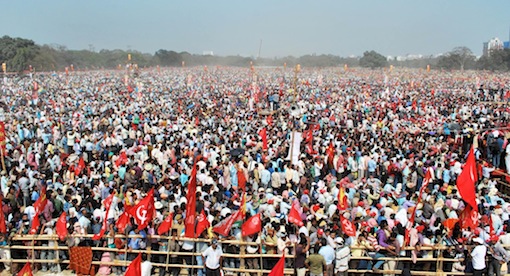
India’s Communist Rally for 2014: A Primer for the Indian Elections

by VIJAY PRASHAD
In March, 788 million Indians will be eligible to cast their ballots in the general election. For the 15h Lok Sabha (Parliament) elections in 2009, about half the eligible voters went to the polls, which means that almost four hundred million people might vote for the 543 parliamentary seats this year. They will be able to vote for one of two major alliances or the regional and Left parties who form the third pole in the Indian polity.
India’s Three Blocs.
The ruling United Progressive Alliance (UPA) is led by the Congress Party, founded in 1885. The UPA has been in power since 2004. It is a center-right alliance, oscillating between a firm commitment to neo-liberal economic policy and a mild form of social welfare. Neo-liberalism’s agenda includes privatization, which means that the government has been the auctioneer of important state assets – it was in this role that the UPA mired itself in a quicksand of corruption scandals. Garroted by the Gandhi family (no relation to Mahatma Gandhi), the Congress as the leading force in the UPA has tried to emphasize its social welfare schemes to no avail. Its leader, Rahul Gandhi, is personable but vacuous.
The Bharatiya Janata Party (BJP), founded in 1980, leads the opposition National Democratic Alliance (NDA). It is a right-wing alliance that is driven entirely by the politics of the BJP, itself the political arm of India’s fascist sector. Aware that its genuine politics of hatred for anyone who is not an upper caste Hindu will not work in India’s diverse soil, the BJP has attempted to put itself forward as incorruptible and the better party to preach the gospel of the free market. Its standard-bearer, Narendra Modi, carries with him a bilious record as chief minister of Gujarat. He says that Gujarat is a model for development, which is of course correct if “Gujarat” simply refers to its capitalist class; others have not fared well at all. Modi is also aware that his own background – as the cheerleader for the 1999 anti-Christian pogrom in Dangs and the 2002 anti-Muslim pogrom across the state – is a liability; he would prefer to talk about higher education and jobs, although every once in a while the smile drops and the viciousness is evident. An explosive article in Caravan by Leena Gita Reghunath implicates Modi in the career of Swami Aseemananda, the mastermind of the 2006-08 bomb blasts in India. Modi’s supporters are deaf to this record, to their own peril.
The third bloc comprises the regional parties and the Left Front. To win a majority in the parliament one of the blocs must win 272 seats. In the last election, the Congress alone got 203 seats and the BJP won 117 seats. It is very unlikely for either of these parties to get the 272 seats by themselves. They must draw in the regional parties into their alliances. Each season the regional parties play hard to get, jockeying for the greatest spoils before they commit to one or the other bloc. These regional parties typically have little problem with neo-liberal policy but they are not as keen on the BJP’s fascism. It is what has saved the lackadaisical Congress. This year, a group of regional parties will once more try to form a Third Front, which will be backed by the Left Front. Three parties from northern India have formed an alliance, as the Left Front ties up with one party from southern India. Everything is in flux. A new regional party – the Aam Aadmi Party – made a spectacular electoral gain in Delhi. It is an anti-corruption populist force that wishes to enter the parliamentary elections in other states. It is not clear how they will do.
Left Front Rally, February 9, Kolkata, Debasish Chakraborty.
The Left Front.
If there is to be a Third Front, its backbone will be the Left Front. The Left in India can be found in struggles across the country – from the fight against Khap Panchayats in Haryana to the anti-caste fight for temple entry in Tamil Nadu (for a good introduction, see Elisabeth Armstrong’s Gender and Neoliberalism: The All India Democratic Women’s Association and Globalization Politics, 2013). But electorally, the Left Front makes an impact in only three states – Kerala, Tripura and West Bengal. In the last election, in 2009, the Left Front suffered a decisive defeat, winning only 25 seats (down from 58). The reasons for this defeat are complex. In West Bengal, they were clearest. The Left had governed here since 1977, and had over the thirty-four years picked up the habits of power despite periodic attempts at “rectification.” Two major setbacks occurred for the Left over its industrial and land acquisition policy. An attempt to set up an auto factory in Singur backfired when the Left failed to build the consent of all those whose land needed to be procured. The disaster of Singur was built upon by the entire opposition in rural Nandigram. Claiming that there was a land acquisition notice, an alliance of the armed Maoists and the current ruling Trinamul Congress Party (TMC) seized the area and barricaded it against state officials. The police entered Nandigram, killing 14 people in the bargain. At that time, the Left Front was blamed for the police firing. A Central Bureau of Investigation report now shows that the government was not implicated in the shooting. Nonetheless, Singur and Nandigram sunk the Left in the elections.
Once in power in West Bengal from 2011, the TMC ruled with an iron hand. Between May 2011 and mid-January 2014, its people killed 139 cadres of the Left Front’s main constituent, the Communist Party of India (Marxist). Most recently, on February 6, eight TMC men in Howrah kidnapped and raped two women (ages 27 and 43) for being members of the CPI-M. “You have to join the Trinamul,” they apparently told the women. “We have been telling you to do so for some time, but you have been ignoring us.” One of the women recalled that they were told not to go to the February 9 mass rally called by the Left Front in Kolkata. The TMC’s leader, Mamata Banerjee, has been tone deaf to this incident, and to the epidemic of violence against women in the state. There has been a 60 per cent increase in rape in the state since 2011, when the TMC took power (according to the National Crime Records Bureau). This is twice the jump in national statistics.
Despite the intimidation of the TMC, over a million women and men gathered in Kolkata’s Brigade Ground on February 9 for an enormous show of strength of the Left Front. This has been the largest rally of the election season. Former Chief Minister, Buddhadev Bhattacharya, said that this has been the biggest rally he has ever seen. Party members of the four constituent parties of the Left Front joined sympathizers – they stood side by side with those who were simply fed up with the TMC. Reports of violent attacks against those who came to the rally began to come in as soon as the rally ended.
A Policy Alternative.
The Left expects to do better in West Bengal than it did in the parliamentary elections of 2009 and the state elections in 2011. If the Left Front is able to win more than the 15 (out of 42) parliamentary seats that it won in 2009, it will be able to leverage those numbers toward a progressive Third Front. Or at least hold the balance in a fractured parliament.
The Left has indicated that it is not interested simply in an alternative front in Parliament. The point is to push for a shift in the policy trajectory. In an editorial for People’s Democracy, the CPI-M leadership elaborated on this distinction,
“The Indian people, if they want to change the situation for the better, will have to use this opportunity provided by the general elections to bring about a political alternative that is capable of implementing alternative policies. An alternative policy trajectory that ensures universal rights and not entitlements to food security; free health care; universal free education; right to employment or adequate unemployment allowance; and universal schemes for the care of the elderly and differently abled, at least, must form the core of such an alternative. This trajectory is preferable not only in humanitarian terms but makes eminent economic sense as well. By thus empowering the people, their purchasing power will substantially increase generating the much-needed additional aggregate domestic demand which, in turn, will provide the impetus for manufacturing growth and, hence, employment. This would set in chain a motion of sustainable and more equitable growth trajectory. That there are resources to sustain such a strategy is obvious if the humongous corruption scams are prevented and the massive tax concessions to the rich are instead used for public investments to build our much-needed infrastructure generating substantial new employment. What the country needs is a political alternative that can put in place such an alternative policy trajectory.”
There is little expectation that the current political calculus can produce such a clear policy shift, but if the Left were able to increase its electoral strength it would be able to push as hard as possible in this direction. Anything less than this would be ruinous for the Indian people.
Vijay Prashad’s latest book is The Poorer Nations: A Possible History of the Global South (Verso, 2013).

Tuesday, June 11, 2013

Indian Fascism’s Putrefication : The Art of Political Murder


By VIJAY PRASHAD

COUNTERPUNCH, June 10, 2013

The iron has gone deep into the soul of West Bengal’s ruling party, the Trinamul Congress. On the morning of June 9, 2013, as he left his home for his morning walk, the Communist leader Dilip Sarkar, age 65, was shot by four “unidentified miscreants,” as the national news agency (UNI) put it. There is little doubt that the hand of guilt will slowly move toward the ruling party, the Trinamul Congress, led by Mamata Banerjee. The murder took place in Burnpur, an industrial city in Asansol district, which is the home of the IISCO steel plant. Sarkar’s political career began there as he rose amongst the ranks in the trade union to become the head of the Steel Workers’ Union. A member of the Communist Party of India (Marxist), CPI-M, Sarkar would represent the interest of workers in West Bengal’s legislature, where he represented the steel workers’ district. His death is a blow to the Left’s resurgence in the area. But it is important to underline that his is the third political murder in the district, after the murder of CPI-M activist and employee at the Lisco steel plant Nirgun Dubey, age 50, in July 2011 in Burnpur, and the murder of CPI-M activist Arpan Mukherjee, age 54, in Burnpur again in May 2012. There is a concerted effort in this belt to wipe out people who have been part of the resurgence of the Left in this area since 2009.

These puncutated killings are not unique, and nor has it been solely a targetted attack on the Left – although these political murders are part of what appears to be a policy to assassinate its ground level leadership. Over the course of the past few years West Bengal has seen the ruling Trinamul Congress Party, feted by the US government, cover up the murder by its cadre and its police forces a student activist, a police officer, and several opposition political figures (including from the Congress Party) as well as seen its leader threaten college professors, doctors and trade unionists with grave language. When videos show her party leaders and cadre directly involved in the public assassinations these men are hastily disassociated from the party, and in some cases, guileless and likely moderately paid substitutes have taken the fall for them. On the street the word is that the supari or payment for some of the killings of the CPI-M leaders could not be more than Rs. 2 lakhs – about $4,000, a measly sum. Political murder is certainly a weapon used by this brand of West Bengali fascism to exocise the Left. But this is not all that is afoot. There is a concerted effort to undermine the apparatus of the State, to intimidate its officialdom into fealty to the Trinamul. That is a policy that has been substantially enacted.

NaMonea.

At the other end of India, in Goa, the official party of Indian fascism, the BJP, has anointed its new leader, the Gujarat Chief Minister Narendra Modi. Modi has few counterparts in the world; analogies do not stick to him. He is a master of the media, having trafficed a vision of himself that has been taken without investigation by corporate journalists. Having risen in the BJP’s spear, the RSS, Modi told hold of the party apparatus in Gujarat where he oversaw the deliverance of the state both to the power of corporations and to the lathery scum of Hindu revanchism. It was the latter that happily went into the forests of Gujarat to torment the Christian tribals of the Dangs belt in the late 1990s and it was they who enjoyed the impunity afforded them to conduct the Gujrat pogrom against Muslims in 2002. Modi has tried to soften his image a little for the general public, appearing as the Avatar of Development and Good Governance. The true believers do not need to hear him frothing about the dangers of Muslims; his bonafides are clear from 2002. They have allowed him to recast himself as the man who will take India away from corruption and put down the hammer against all manner of anti-national tendencies (the great code for continuing the quiet war in Kashmir, the Indian North-East and in the lucrative mining districts at the geographical heart of India).

At Goa, the BJP finally gave this Gujarati Caesar the crown; he is to lead the party into the national elections of 2014. Jubiliation can be felt amongst the ranks of the BJP, whose pressure finally moved sections of the cautious national leadership to go with Modi. This cautious leadership rightly knew that the BJP cannot win power in Delhi on its own. It requries a coalition, their NDA, many of whose partners are wary of Modi and his hard-hammer fascism. They would prefer the recondite fascism of the older leaders – A. B. Vajpayee and L. K. Advani, both nasty specimens who emerged out of the far right’s cabinet of curiousities, but nonetheless able to cloak their views behind the illusions of chaste Hindi or an upper class pedigre. Modi has none of that. His is the politics of the lathiar, the Man of the Stick.

The ruling Congress alliance has allowed Modi and his Saffron Shirts to sharpen their sticks. During his anointment in Goa, Modi made light of the government’s development campaign whose slogan is Aapka Haq (Your Rights). It is rather Aapka Shaq, he said, your suspicion of the government. This is of course true. The expanding, but demographically minor, middle-class has certainly been inflamed as one corruption allegation after another has weakened the Congress. There is no doubt that the values of neo-liberalism have not only given licence to big business, but they have spread their wings into every cultural nook – including Cricket, where betting and spot-fixing scandals have tarnished the sport. The national consciousness is not, however, framed only by the suspicion of the government because of corruption. Livelihood is a central problem for the vast majority, but it is rarely the case that an election will be fought on the sociology of starvation. It will rather be fought contituency by contituency, with factors of caste and gender, political tradition and political violence as the main vectors.

In West Bengal, for instance, where the political violence has become truly dangerous, the local self-government polls are on hand. The Trinmul Congress’ district committee president from Birbhum Anubrata Mandal told a party meeting on June 2 that since the process of filing nominations was going to start the next day, his party had to be alert. “Both the CPI-M and the Congress are our enemies,” he said in a video clip that aired on television channels. “Do not allow anybody from the CPI-M or the Congress to file nominations for the panchayat elections.” Elections are not won solely by the fealty of a section of the population to this or that political tendency. They are won, in the world’s largest democracy, by money and force, by the forces of rotting fascism.


Thursday, April 11, 2013

Bengal’s Slide into Fascism

By Vijay Prashad

On April 2, the four major student union federations jointly held a protest against the withdrawal of campus democracy in West Bengal. They wanted elections to be held for the student unions in their colleges. A tsunami of neo-liberal reforms in higher education had made the students restive. It was not just a matter of higher fees that exercised them. They were also furious at changes in the character of the education – with a tendency to yoke education to careers and to measure learning with fealty to rules developed in the North Atlantic. Thousands of students chanted their way down Kolkata’s College Street and assembled in Rani Rashmoni Road. They faced a police line, which advanced with unpleasant motives. The police arrested hundreds of students and threw them into private buses to be transported to Alipore Jail. On the buses, the police beat the students affiliated with the Communist’s Student Federation of India (SFI). One SFI leader, Sudipta Gupta, age 23 and a recent Political Science MA from Rabindra Bharati University, was beaten, thrown from the bus, retrieved, and beaten again. He died within hours of being admitted to SSKM Hospital.

The Chief Minister of West Bengal, Mamata Banerjee of the Trinamul Congress (TMC), said that his death was “an accident.” She was at that point opening the new season of the Indian Premier League cricket tournament. Despite hearing of the death of Gupta, she remained at the celebrations. Her police said that Gupta had been “man-handled,” although her consigliere, Derek O’Brien said that CCTV would vindicate Banerjee’s statement about the death being accidental.

Anger in the Left has been growing steadily. Gupta is the 93rd left cadre killed by the state forces or the Chief Minister’s party over the course of the past few years. It is in this context that the Communist Party of India-Marxist (CPM) leader Mohammed Salim asked, “what kind of fascism is this?” Banerjee and the TMC have not only targeted the Communists – anyone who crosses her path must be excised, whether someone who simply forwards a cartoon critical of her (Jadavpur University professor Ambikesh Mahapatra was arrested for defamation and passing offensive messages through the Internet) or someone who asks her a question at her public meetings (farmer Shiladitya Chowdhury of West Midnapore who asked, “What are you doing for farmers? Farmers are dying because they have no money. Empty promises are not enough,” and who was then arrested on grounds of criminal intimidation). Her party has taken its worship of her seriously (see the picture of a temple dedicated to her). If anyone insults Banerjee, the TMC will send its men to collect its blood debt.

The level of casual political violence in the state is startling. Activists of the ruling TMC had in February of this year clashed with activists of the Congress Party as both their candidates tried to file papers to run in student elections for Hari Mohan College in Kolkata’s Garden Reach area. Fists turned to guns and a policeman, Tapas Chakroborty, was killed. Nothing will come of it even though video shot at the scene shows TMC activists (including a local TMC councillor Mohammed Iqbal) involved in the fracas.

Two days after the murder of Gupta, the SFI held national protests and demanded that the Central Government hold an inquiry into the nature of his death – any state inquiry would be compromised by the culture of impunity that has begun to enfold the state. Only those who make noises about the government, such as Kolkata’s chief of police R.K. Pachnanda after the death of his officer, are transferred into limbo.

On April 9, Banerjee and her Finance Minister Amit Mitra came to Delhi to visit the Planning Commission. A demonstration against the murder of Gupta led by the Left greeted them. The Planning Commission heard of the demonstration, contacted the West Bengal officials to have Banerjee come through the secured VIP gate and avoid the main gate where the protestors had gathered. Banerjee not only ignored their advice, but near the main gate she got out of her car and walked toward it, through the highly emotional throng. It was an act of provocation. The Delhi police did not forcibly prevent her from doing this. Knowing full well the charged state of the demonstrators – gathered to protest the murder of a young comrade and Banerjee’s callous statements – the police should have insisted. It did not. Banerjee know full well the power of street politics. In April 1975, when she was with the Congress Party, her leader Indira Gandhi’s bête noire, 74-year old Jayaprakash “JP” Narayan, came to Kolkata. Banerjee personally blocked his car (standing on its bonnet) as Youth Congress activists smashed the windows, and almost beat up JP who suffered from acute respiratory ailments, which would have killed him if the stress were kept up. She a remarkable populist street fighter knew what she was wading into when she walked to the main gate.

In fact, all that happened to her, according to the Delhi Police, is that she was buffeted by the crowd (when she returned to Kolkata she checked herself into Belle Vue Clinic for a “check up”). Her Finance Minister lagged, and was himself caught in the wave, with his kurta slightly ripped as he struggled to make it through the gate. The police grabbed him and brought him within the premises of the Commission. This was not an attack, certainly not premeditated as the Bengal Governor put it indelicately. It was a crowd that found itself with those whom it had come to protest within its ranks – it would have taken an extraordinary act of self-discipline to have stepped back, created a path for them and held their tongue. One expects this kind of discipline from Communists, which is why the CPM made it clear that it did not condone the assault.

News of these events spread through the TMC channels, and its activists took to Bengal’s streets for revenge. It is not as if the TMC has been silent and that it took this scuffle in Delhi to provoke them. They have already been on the march, and simply used this as a pretext to continue their depredations – now in the full light of day. CPM and SFI offices across the state were attacked, as were academic institutions (a friend called to tell me that the laboratory at Presidency College was smashed up). Most shockingly, TMC activists attacked the office of the Ganatantrik Mahila Samity (the Bengal wing of the All India Democratic Women’s Association) in South Dinajpur, dragged onto the streets its leader, the veteran Communist and former parliamentarian Minati Ghosh and physically attacked and verbally abused her. AIDWA and the National Federation of Indian Women have called on the National Commission of Women to look into this case.

Things are at a tense pass. Activists of the Left have been called up to defend the buildings of the party and its mass organizations. The violence unleashed has the quality of the early hours of the Night of Broken Glass (the Kristallnacht), this time not against Jews but against the Communists. It is the reason why the CPM and its allies have tried to calm the situation – not only a sensible posture but also one that is motivated by its weakness before the fascistic character of the TMC. No liberal groups have come forward to defend the Left against TMC fascism. The media has taken the drama full tilt, neglecting to properly report the shenanigans of Banerjee and the negligence of the Delhi police. The media will not let this be in context. It is using the incident outside the Planning Commission to shore up the declining fortunes of the TMC machine, whose votes will be essential in the next parliament for a Congress-led bloc that now feels threatened by its own inadequacies.

Tuesday, February 2, 2010

Maoism at Its Nadir:The Killings in Bengal


By VIJAY PRASHAD

Violence in West Bengal’s western districts has reached crisis proportions. Each day, one or more cadre member or sympathizer of the Communist Party of India (Marxist) [CPM] is killed either by Maoists or the Trinamul Congress (TMC). The Maoists have found common cause with the TMC, a breakaway from the Congress Party in Bengal. Mamata Banerjee, whose authoritarian populism draws from both Juan and Evita Peron, leads the TMC. Backed by the dominant class, Banerjee nonetheless drapes herself in mystical radicalism (didi, or sister, as she is known, becomes durga, the embodiment of shakti, female power). In October 2009, the Maoists declared that they would rather have Banerjee’s right-wing TMC rule Bengal than the Left Front.

The Maoists-TMC has now killed over two hundred people since late 2007 (most are members and supporters of the CPM, with just a few being members of other political parties that are either in the Left Front or else affiliated with it). Ordinary political workers are beheaded and burnt, shot in the head and raped. In early January, Maoists entered the village of Joynagar and killed four CPM supporters; they beheaded two of them, Anath Singh and Hiteshwar Singh, sons of Gopal Singh who the Maoists killed in 2007. Ten days later, TMC members attacked a group of CPM supporters who had just filed their nomination papers for a local election. Dinesh Haldar, Khairul Jamadar, Biswanath Gayen and Salim Jamadar were killed, two of them with revolvers fired into their mouths. These monstrous acts are ongoing, and systematic.

Defenders of the Maoists suggest that the guerrillas only channel the anger of the poor, that this is the politics of rage against a system that has not delivered any goods. In the midst of this bloodbath, the writer Arundhati Roy told IBN-CNN’s Karan Thapar that the Maoists are justified in their armed path. “You have an army of very poor people being faced down by an army of rich that are corporate-backed,” she said. The suggestion is that the Maoists are the army of and for the poor, whose actions are motivated by the failure of the Indian State to deliver on its Constitutional promises. But this is not only simplistic; it is also disingenuous.

About half of India’s population falls into the World Bank’s category of poverty; that’s about 500 million people. Most of them have grievances and aspirations, but these do not lead them to the gun. The poor can be found in one of the many political organizations that seek to widen and deepen the current legal dispensation in India, fighting for the rights of the people through the courts and in the streets. Or else, the poor can be found in and around the NGOs and social service agencies that serve their needs; as well, the poor can be found in one of the many Rural Employment Guarantee schemes set up by the government. The Indian government’s obsession with growth rates for the wealthy diverts the nation’s wealth away from the workers who produce it. Anger and frustration at the system does not necessarily turn to anomic violence of the kind practiced by the Maoists and the TMC in western Bengal.
Poverty does not lead to Maoism. It certainly contributes to it, but it does not produce it. What produces Maoism is the act of making political violence legitimate (even glorifying it). Rather than make the case that there is space within the (however limited) democratic institutions, people like Arundhati Roy trumpet the armed road. Patient work through the democratic institutions produced the important developments for the Dalit [oppressed caste] movement and the working-class movement. For example, Reservations for underprivileged castes did not come from the armed struggle. It was a direct beneficiary of the use of the democratic institutions. The gun is an anthem for the deracinated middle class romantic, but not the glory song for the dispossessed, for whom only suffering comes at the gun’s mouth. It is the dispossessed who die in these armed struggles, both from the guns of the revolutionaries and those of the State.

In South Asia, the recent examples of organizations that thrive on the cult of violence include the Liberation Tigers of Tamil Eelam (LTTE) and the United Liberation Front of Asom (ULFA). The Maoists glorify both of these groups – they have recently procured the arms that ULFA was to send to LTTE. When the Sri Lankan army killed LTTE’s leader Prabhakaran, the Maoist leadership conducted a strike on his behalf (when the LTTE was decimated in Sri Lanka, the Indian Maoists claimed that this would have “a negative effect on the revolutionary movement in India as well as South Asia and the world at large”). To glorify violence, as the Maoists do, does not open the kind of political space necessary for the end to the poverty-making machine that has afflicted many parts of rural India. Their slogan is borrowed from the Italian ultra-left, ni mai piú sin fucile, Never Again Without a Rifle.
The Maoists have taken advantage of poverty, but they have nothing to offer by way of a salve. In the largely tribal areas of interior India, the various extractive mafias are at work drawing out the wealth of the region and providing little for the residents. Raw materials of all kinds, from timber to dolomite, routinely leave the tribal zone with little recompense for the people themselves. The Maoists have entered this highly exploitative and oppressive situation with no plans to immediately assist the grievances of the various tribal communities. Indian Maoist leader Koteshwar Rao (Kishenji) told the press, “We collect taxes from the corporates and big bourgeoisie, but it’s not any different from the corporate sector funding the political parties.” The mafias continue to operate; indeed the extortion payments to the Maoists give them permission to work with license. One estimate suggests that the Maoists make off with Rs. 20,000 million per year, money used, among other things, for the purchase of arms.

If the government attempts to provide any sops toward development (such as schools and medical centers), the Maoists simply blow them up (this is clearly documented by Human Rights Watch in Sabotaged Schooling. Naxalite Attacks and Police Occupation of Schools in India’s Bihar and Jharkhand States, December 2009). It is to their interest to allow matters to remain in stasis within the “liberated zones.” It is specious to talk of the Maoists as liberators: they are infected with the virus of extortion and power.

This brings us back to a central unasked question: why are the CPM members and supporters the target of the Maoist-TMC violence in Bengal? The Maoists and their TMC allies do not kill the mafia, for that is their cash cow. Nor do they turn their guns on local landowners or dominant classes. In Bengal, they reserve their ammunition for schoolteachers and agricultural workers, workers in the mines and workers in the panchayats [institutions of local self-government]; all of whom have one thing in common, an affiliation of some kind in the Communist Party of India (Marxist). This assault on the CPM is not new. In 1983, journalist Praful Bidwai wrote, “Often the affirmation of the revolutionary identity of naxalism [Indian Maoism] means singling out the CPM and the CPI for an onslaught because, according to their theory, those parties can be nothing but obstacles to the popular movement,” viz. the growth of the Maoist parties, which stand in for a genuine mass movement. “The anti-CPM and CPI aspect of naxalism is not new. The point is that it has become increasingly more important over the recent past as the naxalite survival has been threatened.” The Maoists do not fear for their survival any longer; rather, they want to use the weapon of violence in Bengal to enter into a state where they have had limited traction.

The Maoist-TMC conduct most of their assassination and political terror in the region of the Jhargram parliamentary constituency. This is a constituency reserved for tribal candidates. In 2009, the CPM and its Left Front allies suffered a setback across West Bengal during the parliamentary elections. Jhargram was another story. Here, the CPM’s Pulin Behari Baske won the election by almost 60 per cent of the vote. One reason Baske won is that the region’s tribals have been a beneficiary of the long struggle for land reforms spearheaded by the CPM and its Left Front allies. This is not a prosperous region, but it is nothing like the devastated areas in Central India where the Maoists have established themselves. Unable to secure a political victory, the Maoists-TMC has turned to the gun. They assassinate the CPM workers and supporters to terrorize the population against the Left Front.

Vijay Prashad is the George and Martha Kellner Chair of South Asian History and Director of International Studies at Trinity College. His most recent book, The Darker Nations, won the Muzaffar Ahmed Book Prize in 2009, and is now available in French as Les Nations Obscures(Les Editions Écosociété). He is an editor of Naked Punch. He can be reached at vijay.prashad@trincoll.edu.

Weekend Edition

COUNTERPUNCH, January 22 - 24, 2010