Showing posts with label BUDDHADEB. Show all posts

Saturday, March 21, 2015

CPI(M) West Bengal 24th State Conference Calls to Intensify Struggles

By Debasish Chakraborty

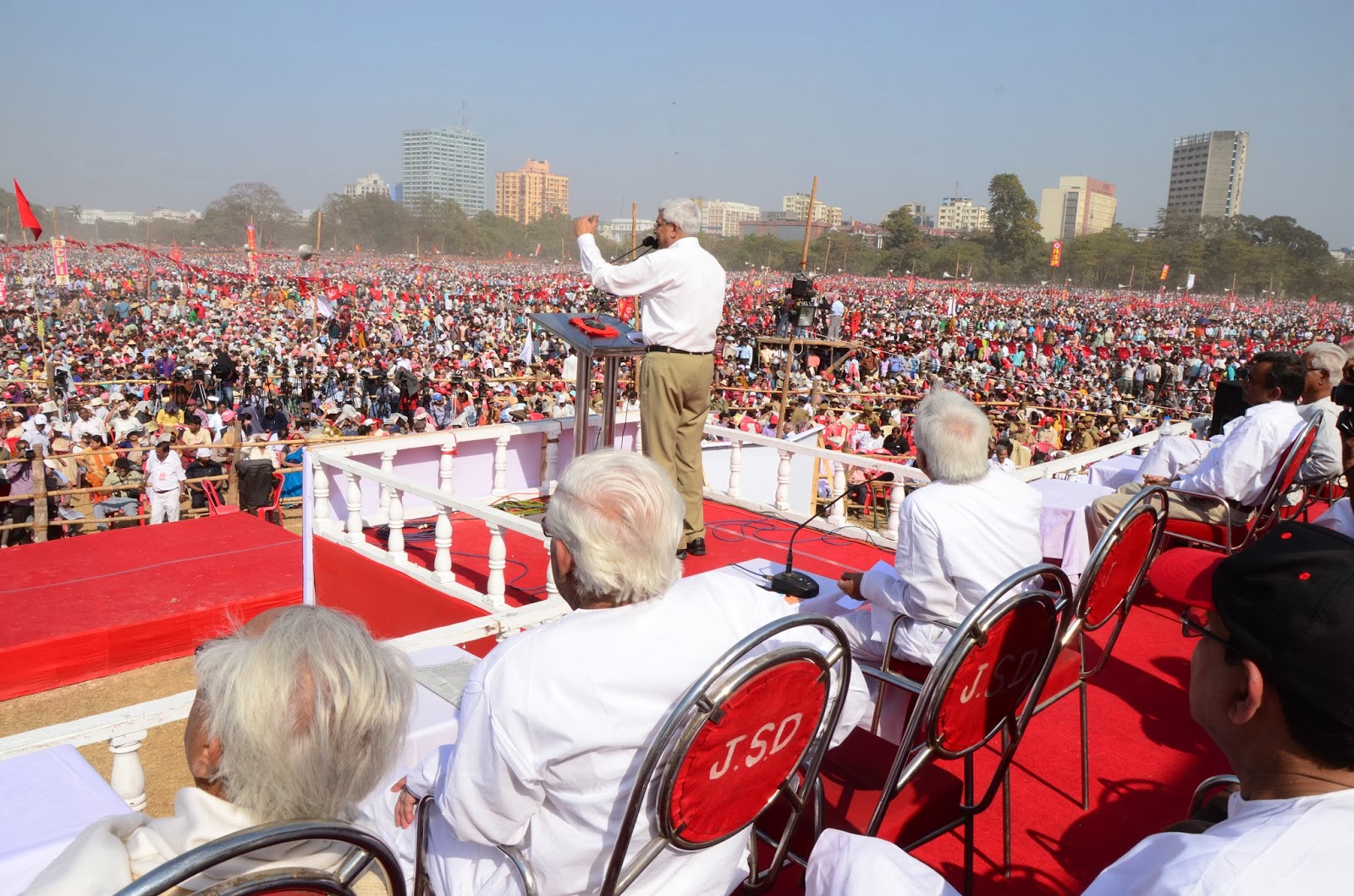
THE 24th state conference of the CPI(M) West Bengal  committee started with a massive rally at the  Brigade Parade Ground in Kolkata on March 8 and after five-days of deliberations concluded on March 13 with the battle cry to ‘Oust Trinamool, Save Bengal’. The conference, held in Promode Dasgupta Bhaban in Kolkata, witnessed threadbare discussions on political situation of the state, organisational aspects of the Party and a thorough review of the work of Left Front government in order to build up a Left alternative programme for the state.

The conference was held at a time when the Party and the Left has survived an all-out terror of the ruling class, suffered electoral losses, is facing new threats of communal forces along with an authoritarian government in the state.

The delegate session started with CPI(M) general secretary Prakash Karat hoisting the red flag in the lawns of the conference venue , decorated by portraits of the departed leaders. Biman Basu read out the condolence resolution. After the last state conference, 106 Left leaders, activists and supporters were killed by ruling party miscreants in the state. Karat and other Polit Bureau members offered their floral tributes to martyrs’ column.

STRENGTHEN PARTY TO BUILD UP MOVEMENTS

In the political-organisational report, placed by the outgoing secretary Biman Basu and later adopted in the conference, a self-critical analysis of the Party’s work was done. With the determination of Party’s activists and with the growing discontent among people, some perceptible changes in the situation have occurred in the last few months.

The future tasks outlined in the report emphasise that in the changed situation, we have to mobilise working people and other sections of the masses that are affected by the policies of the centre and state governments, those who have become victims of the attacks from TMC-abetted anti-socials and joint attacks of criminals and police, and move forward.

Specific tactics have to be adopted in each local and branch areas, depending on the specific reality of the area. We have to remember that there will be difference in style of functioning from the past. But our main goal is to firmly consolidate our class allies and win over general masses and democratic sections. The changes occurring in the society due to neo-liberal policies and its effects on class and social formations should be kept in consideration. Otherwise, there will be mistakes in deciding democratic allies in villages and urban areas, noted the report.

The report emphasised on the change of style of work. It said, ‘Leadership has to work down below, along with those comrades who have worked with risks and responsibility in the last three years. Attending LC and branch meetings are not enough. The district leadership and district committee members working in zonal level must adopt this practice.’  The report identified two tasks as priorities: to get rid of the problem of inactivity in the Party which means develop the Party ideologically, develop the communist values of comrades at all levels and activate them in the fields of struggle according to the organisational principles. At the same time, developing intensive relations with people along with toiling people is needed. The conference also identified the crucial importance of energising the mass organisations with proper monitoring of their independent activities.

While summing up the discussion of 60 delegates on the political-organisational report, Biman Basu said that the positive changes in the situation have to be utilised to build up wider movements. And to do this the Party organisation has to be prepared. The adverse situation can only be overcome through movements.

STRUGGLE FOR LEFT ALTERNATIVE

The conference discussed the review report on the working of the Left Front government. As Suryakanta Misra put it while introducing, it is not only a review of the past but was aimed to develop an alternative programme for the state. ‘Not that we will implement it only when in government, but also keep it in the forefront to intervene on issues as opposition too’, he said. The report itself analysed the backdrop of the formation of the LF, undeniable achievements, the advent of neo-liberal policies and the resulting challenges, the shortcomings and mistakes.

The report was made a public document before the conference and comments and suggestions poured in through e-mail and websites. Summing up the discussion of 27 delegates on it, Buddhadeb Bhattacharjee  said,  the experience of running a government for 34 years was unique and its lessons should be summed up for Left movement in our country and for the Marxists all over the world.

He said, the achievements of the LF government have to be seen in class terms.  Land Reforms were the major success of the Left Front government in West Bengal that distributed 11, 27, 000 acres of land among 30 lakhs of peasants. Not Just decentralisation of power but empowerment of poor people was our achievement. Not just enhancement of agricultural production but improvement of purchasing power of common people was our achievement. The Left Front government was based upon four pillars: a) success in agriculture; b) considerable human development; c) enhancement of democratic rights; d) to firmly establish secular environment in the state;

Bhattacharjee said, with the advent of neo-liberal policies we faced a new challenge to defend the marginalised people. We initiated social security measures for unorganised workers and marginal sections, provided rice at Rs 2 per kg etc.

On industrialisation, Bhattacharjee said, our programme was to revive industrialisation in the state. Former chief minister and our leader Jyoti Basu had taught us to take maximum benefit out of the situation that arose in the nineties. We had to go for private capital, knowing full-well that they would come here for profits only. Our interest was to enlarge the scope of employment. Our industrialisation policies attracted investment, the highest amount being Rs 15,000 crores in 2010. Land acquisition never posed a major problem amongst people in West Bengal. Land was acquired even before Singur and after. We basically wanted just 1 per cent of total cultivable land. In North Bengal, Medinipur, Barrackpore, Rajarhat, South 24 Parganas we never faced any problem. But in Singur the situation went out of control. We admitted in our document that there was a lack of understanding on the question of peasant’s attachment to land. In Nandigram, the situation was different. However what happened there cost us dearly in the state and had its negative impact on the Left movement in the country.

As the document itself outlined, Bhattacharjee admitted that there was unnecessary intervention in educational sphere, partisan divide between rural people in distribution of benefits, high handedness in some areas. ‘In a democratic country like ours, the plurality of thought must be respected’, he commented.

Bhattacharjee said, the success, weaknesses and the lessons would help us to develop the alternative for the future. We will go the people with this alternative. The change of political situation in the state will come surely but only through sustained movement. The Party should develop in a way that gains trust and respect of the people.

The state conference concluded with the call of ousting Trinamool Congress government to save West Bengal. In the concluding session, the conference adopted a resolution calling upon the people to organise to defend democracy, strengthen secularism, and fight against unprecedented corruption in the state. CPI(M) has called for industrialisation of the state which is suffering from critical decline of industries in the last three and half years resulting in perilous growth of unemployment. The conference called upon to initiate movements for remunerative prices of agricultural products. The Party will increase its initiative to unite Left, democratic and secular forces to defend democracy and resist the politics of division among people.

The conference elected Suryakanta Misra as new secretary of the state committee. An 81-member state committee has been elected, with three vacancies to be filled later.

Biman Basu, the outgoing secretary took charge in 2006 after Comrade Anil Biswas expired. Later Basu was elected as state secretary in 2008 and 2012 conferences. Biman Basu led massive student-youth movements in 1960s and 1970s. Later, he helped to build up Party in many districts of the state. He was the chief initiator of mass literacy movement also. A tireless leader, Biman Basu is Polit Bureau member of the Party.

Suryakanta Misra joined in the Party through student-youth movement. A doctor by education, he hails from undivided Midnapore. He was the district council president of the district in the three-tier panchayat and gained popularity through massive land reforms and rural development work in the district. A peasant leader, Misra later became a minister in Left Front government, in which he worked in health, panchayat, rural development ministries. He became a state committee member in 1988, state secretariat member in 1995, central committee member in 2002 and member of the Polit Bureau in 2012.  Currently, he is also the leader of the opposition in the state.

The new state committee included 20 new members with 18 of them from younger sections. The new members are: Narayan Biswas, Apurba Paul, Niranjan Sihi, Ajit Pati, Aniruddha Chakraborty, Ratna Dutta, Saman Pathak, Jiaul Alam, Robin Rai, Debabrata Ghosh, Mansa Hansda, Somnath Bhattacharya, Mrinal Chakraborty, Palash Das, Rupa Bagchi, Gauranga Chatterjee, Dilip Ghosh, Gargi Chatterjee, Tamser Ali, Meghlal Sekh.

Nirupam Sen, Md Amin, Raghunath Kushari, Banani Biswas, Prasanta Pradhan, Dinesh Dakua, Hasim Abdul Halim are among 11 special invitees.

The conference elected the new State Control Commission of the Party, where Kanti Biswas has been elected as new chairman.

The conference has also elected 175 delegates for the 21st Party Congress.


Polit Bureau members Sitaram Yechury, S Ramachandran  Pillai, Brinda Karat, Manik Sarkar, Tripura state secretary Bijan Dhar and Assam state secretary Uddhav Burman also attended the conference.

Sunday, March 15, 2015

We will Develop a Left Alternative and Go to the People: Buddhadeb

Buddhadeb Bhattacharjee Sums up Discussion on LF Government


Time has come to fight back. Battle is not over. CPI (M) can bring the democracy back in West Bengal, stated CPI(M) Polit Bureau Member Buddhadeb Bhattacharjee while summing up the discussion on the Draft of “The Left Front Government in West Bengal: Evaluation of an Experience” in the 24th Conference of CPI(M) West Bengal State Committee at Pramode Dasgupta Bhavan, Kolkata.

In his summing up speech Buddhadeb Bhattacharjee started the discussion saying that Polit Bureau and Central Committee wanted a detailed discussion on the 34 years of experience of the Left Front Government in the state.

The contemporary global situation throws a major challenge of Marxist thoughts and is going into a massive political transformation. In such a situation many people from various corners of the globe are expressing their interest in the application of Marxist ideology in West Bengal through Left Front Government. We also are well aware of the recent critiques on various writings and contributions of global intelligentsia about contemporary Marxist outlooks and give necessary suggestions on our performance too. Our final goal is to establish People’s Democracy in our Country.

‘Land Reforms’ was the major success of the Left Front Government in West Bengal that distributed 11, 27000 acres of land among 30 lakhs of peasants. Not Just decentralization of power but empowerment of poor people was our achievement. Not just enhancement of agricultural production but improvement of purchasing power of common people was our achievement. To mobilize 85-90% of children in primary school was our achievement which is still undeniable.

Left Front government was based upon four Pillars of responsibility:
1. Success in Agriculture; 2. Considerable Human Development; 3. Enhancement of Democratic Rights; 4. To establish Secular Environment in the state. This is undeniable that the Left Front government had achieved a major success in the development of all four pillars.

We had experienced the rise of neoliberal policies in our country and the state that created a new marginal people. The Left Front government special assistance to those marginal people like providing rice of just Rs2 per KG etc. We tried to stand beside these people through social security measures.

On industrialization Bhattacharjee said, our programme was to revive Industrialization in the state. Former Chief Minister and our leader Jyoti Basu had taught us to take maximum benefit out of the situation that arose in the ninties. We decided to go for private capital, knowing fully well that theu would come here for profits only. Our interest was to enlarge the scope of employment. Our Industrialization policies attracted investment which got highest of Rs. 15000 crores in 2010. Land Acquisition was never a major problem in West Bengal. We basically wanted just 1% of total cultivable land. In North Bengal, Medinipur, Barrackpore, Rajarhat, South 24 Parganas etc we never faced any problem. But in Singur the situation went out of control. We admitted in our document that there was a lack of understanding on the question of peasant’s attachment to land. In Nandigram, the situation was different. However what happened there cost us dearly in the state and had its negative impact on the left movement in the country.

Bhattacharjee said, the success, weaknesses and the lessons would help us to develop the alternative for the future. We will go the people with this alternative.


Kolkata, 12th. March 2015

Monday, January 5, 2015

Bengal has no place for saffron: Buddhadeb Bhattacharjee


TNN | Jan 4, 2015, 12.24 AM IST

KOLKATA: Former chief minister Buddhadeb Bhattacharjee took stage on Saturday to reassure party supporters that the Left won't allow the BJP to strike roots in Bengal without a political battle.

"Trinamool has lost its moral right to rule Bengal. Even if the media wants the BJP to replace Trinamool, this is not going to happen. Bengal has no place for the saffron," Bhattacharjee said, while speaking at the 48th anniversary of the CPI(M)'s Bengali mouthpiece Ganashakti.

"There is no security in the state. Trinamool Congress has taken Bengal 10 years back. It is a retrogression. Chief minister Mamata Banerjee has created a precedent. A state minister is now in jail. Who are those who are showering petals on him?" Bhattacharjee said.

But, the CPM leader reminded that it doesn't mean that BJP will emerge as the alternative. Bengal has a rich history of struggles — land struggle, Operation Barga initiative, movement for democracy that took shape in formation of the United Front and later Left Front. The BJP didn't figure anywhere in this course of history. Shyamaprasad Mookherjee was a great leader but his descendants couldn't make headway in Bengal," said Bhattacharjee.

The CPM politburo member then pointed to the right wing economic policies of the Narendra Modi government apart from his usual criticism against majority communalism. "BJP is taking the same route the Congress pursued. Modi is doing it vigorously. The BJP has with them RSS. Such policies are deepening the divide between the rich and poor," the former CM said. 

Bhattacharjee cites this as a major contradiction that will heighten further. "There are many rich people in the country. So are the upwardly mobile middle class that swear by Modi. They want more money, new car, new flat, shopping mall...On the other hand, there are a huge number of poor people who can't spend for treatment and education. The confrontation between the two income groups is inevitable. We are for the poor. Let us see where the BJP stands," the former CM said.

Friday, February 14, 2014

Nandigram Myths Decoded: CBI Calls the Bluff

By Nilotpal Basu

HISTORY is cruel; in its own way, it squares up the truth. Seven years back, a rural tract in West Bengal – Nandigram – shot to prominence.  It resonated across the country. The cyber world took it beyond the national boundary and drew international attention. Political observers attributed electoral nemesis of the three decade electoral sway of the Left to the developments in Nandigram.  Nandigram was seen as the ‘diabolical’ anti-peasant face of the Left in Bengal. And overall, it contributed to undermine the credibility of the Indian Left.

What was the background of the unfortunate developments that unfolded in Nandigram in the early days of 2007?  The government of West Bengal in its attempt to industrialize the state had zeroed in on the Petroleum Investment Region scheme mooted by the central government; taking advantage of incentives of the scheme to facilitate the petroleum investment hub where Nandigram would be the core. The requirement for the scheme was a large amount of land.  The locational advantage of Nandigram was its proximity to port city Haldia and existing oil refinery and petro-chemical complex. These existing facilities provided important infrastructure to locate the petroleum investment zone. That agricultural land in Nandigram suffered from salinity, forcing people to migrate for work was another factor which weighed in favour of developing industrial activities in the region.

However, the decision of Left Front government did not find major support from the people. A major factor which affected the mood of the people was the lack of communication. The comprehensive consultative exercise which ought to have helped galvanise popular opinion for industrial activity failed to fructify. And this communication deficit was compounded by a tendentious propaganda blitz by the opposition. A rainbow coalition emerged to oppose acquisition of land for the project.

Taking advantage of the uncertainty that emerged, the broad platform virtually took physical control over the proposed project land. The platform took to violence; digging up roads and blowing up bridges, the entire area went out of the writ of the state government. The law and order situation became captive to these forces. Several killings ensured that discourse on the industrialization agenda could not reach the people. Discussion and debate towards any informed conclusion was the casualty.  

CATCH-22 SITUATION

It was a catch-22 situation for the state government. Given the broad opposition to the project and the related issue of land acquisition, it became clear that without concurrence of people, it was impossible to go ahead with the project; notwithstanding its importance in the overall context of the industrialization agenda. Thus, between January and March 2007, atmosphere of uncertainty and anarchy prevailed in the area.  In February itself, the state government and the chief minister announced that there will be no land acquisition against wishes of the people.  But despite that, the opposition was unrelenting and carried on their violent and lawless ways making the area incommunicado to the state government. The state government was found helpless in ensuring the right of the entrapped citizens. 

And, this was the backdrop of 14th March 2007. A police party which entered the area to restore communication to re-establish rule of law was confronted with. The consequent unfortunate police firing and related incidents resulted in the loss of 14 persons; widespread condemnation against ‘forcible acquisition’ followed.

Nandigram became the symbol around which opposition to the Left government galvanized.  From Maoists on the Left to communal forces of all hues on the Right combined. With TMC spearheading the opposition, its supremo and present chief minister Mamata Banerjee shot into national fame. She became the icon of the anti-Left forces not only nationally but also internationally. Those who were pathologically opposed to the Left catapulted her to lead against hitherto electorally invincible Left; so much so, that she featured on the cover of Time magazine.

Ironically, the Left in India, which had been in the forefront of the struggle for agrarian reforms and land redistribution, was shown as having betrayed that legacy. The overall neo-liberal policy environment featuring large-scale takeover of agricultural land by corporate sharks came to be equated with what happened in Nandigram on the 14th of March.


Of course, there have been several reasons which led to the setback of the Left in the 2009 Lok Sabha elections and assembly elections in 2011; but Nandigram was widely seen as the trigger which set out the course for undermining the credibility of the Left. 

Much as they attempted to explain their approach, the Left failed in getting its message across. Even before the Left Front government could order any independent probe into the firing on 14th March, the Kolkata High Court, at the insistence of the opposition, ordered a CBI probe.

LF GOVT VINDICATED

Finally, the propaganda blitz that led to institution of CBI probe has come full circle. On 18th December 2013, the CBI, after almost seven years of investigation, filed a chargesheet before the court.  The findings could not be any greater indictment of the then opposition led by TMC and its mercurial leader Mamata Banerjee. The CBI findings completely vindicate what the Left government had contended at that point of time.

The CBI chargesheet reveals – “Investigation has disclosed that efforts were made by the district administration and the police officers to normalize the situation in Nandigram. Many meetings were organized between the administration, leaders of the opposition parties and BUPC”; Bhumi Uchhhed Pratirodh Committee (BUPC) being the umbrella organisation spearheaded by the TMC which led the agitation in Nandigram. But, the CBI has now opined that –“However, there was no visible improvement in the law and order situation which remained out of control for the District Civil and Police administration”.

Detailing about how bad the situation was between January and March, 2007, the chargesheet states -“During this period at least 56 FIRs were registered at Nandigram and Khejuri police stations relating to violence, arson, loot and murder etc. The period also witnessed death of 11 persons and injuries to at least 25 persons due to these clashes. A police Sub Inspector namely Sadhu Charan Chatterjee was kidnapped and killed by the mob, police jeeps were burnt and police weapons were looted. The cases registered could not be investigated by the local police as the local police were unable to enter into the villages during this period”.

The chargesheet comprehensively calls the bluff that the police entry was ‘clandestine’. The chargesheet categorically states that - “On 12.03.2007, the state home secretary briefed the press, in which he informed them about the proposed police action in Nandigram”. Subsequently, “it was decided that the police operation would be conducted on 14.03.2007 at three places in Nandigram”.

The firing was ‘after all attempts to disperse the crowd’ who blocked the police entry through requests over PA system, lathicharge, firing of tear gas and firing in the air ‘failed’.

The chargesheet also nails down the claim that there were hundreds of people killed, with gory charges of children and women being torn apart and their bodies smuggled out. The chargesheet categorically points out that ‘opposition consciously spread rumours’ and ‘organised armed men’ to take on police which led to the unfortunate firing.  As if to add salt to injury, the CBI rejected the plea of the TMC that the political leadership of the Left was responsible.  In fact, despite these findings, the current state government and the chief minister has refused to allow CBI to proceed against police and civil officials whom they found to violate some procedures, insisting that Left leadership must be investigated.

The CBI is no ‘holy cow’. Neither has it done anything spectacular to erase the impression that it is not insulated from political interference having earned the description of ‘caged parrot’.  But, TMC and Ms Banerjee have forgotten that for almost six and a half years during which the CBI was carrying out its investigation, it was they who were in company with the ruling Congress – both in the state and the centre.  The state government had every opportunity to inform CBI towards an ‘informed conclusion’ in course of last almost three years; not to forget that this CBI investigation on firing in Nandigram was essentially at their own behest. 


Therefore, it is an irony that truth has finally come through the CBI chargesheet. Those who had chronicled contemporary events during that period will hopefully revisit conclusions that they had drawn on Nandigram – and, more importantly, on the Left and its intentions.

Tuesday, February 11, 2014

LEFT FRONT RALLY AT BRIGADE PARADE GROUND ON 9TH FEBRUARY, 2014


https://plus.google.com/u/0/photos/107460306998502333712/albums/5978744569589924913

India’s Communist Rally for 2014: A Primer for the Indian Elections

by VIJAY PRASHAD
In March, 788 million Indians will be eligible to cast their ballots in the general election. For the 15h Lok Sabha (Parliament) elections in 2009, about half the eligible voters went to the polls, which means that almost four hundred million people might vote for the 543 parliamentary seats this year. They will be able to vote for one of two major alliances or the regional and Left parties who form the third pole in the Indian polity.
India’s Three Blocs.
The ruling United Progressive Alliance (UPA) is led by the Congress Party, founded in 1885. The UPA has been in power since 2004. It is a center-right alliance, oscillating between a firm commitment to neo-liberal economic policy and a mild form of social welfare. Neo-liberalism’s agenda includes privatization, which means that the government has been the auctioneer of important state assets – it was in this role that the UPA mired itself in a quicksand of corruption scandals. Garroted by the Gandhi family (no relation to Mahatma Gandhi), the Congress as the leading force in the UPA has tried to emphasize its social welfare schemes to no avail. Its leader, Rahul Gandhi, is personable but vacuous.
The Bharatiya Janata Party (BJP), founded in 1980, leads the opposition National Democratic Alliance (NDA). It is a right-wing alliance that is driven entirely by the politics of the BJP, itself the political arm of India’s fascist sector. Aware that its genuine politics of hatred for anyone who is not an upper caste Hindu will not work in India’s diverse soil, the BJP has attempted to put itself forward as incorruptible and the better party to preach the gospel of the free market. Its standard-bearer, Narendra Modi, carries with him a bilious record as chief minister of Gujarat. He says that Gujarat is a model for development, which is of course correct if “Gujarat” simply refers to its capitalist class; others have not fared well at all. Modi is also aware that his own background – as the cheerleader for the 1999 anti-Christian pogrom in Dangs and the 2002 anti-Muslim pogrom across the state – is a liability; he would prefer to talk about higher education and jobs, although every once in a while the smile drops and the viciousness is evident. An explosive article in Caravan by Leena Gita Reghunath implicates Modi in the career of Swami Aseemananda, the mastermind of the 2006-08 bomb blasts in India. Modi’s supporters are deaf to this record, to their own peril.
The third bloc comprises the regional parties and the Left Front. To win a majority in the parliament one of the blocs must win 272 seats. In the last election, the Congress alone got 203 seats and the BJP won 117 seats. It is very unlikely for either of these parties to get the 272 seats by themselves. They must draw in the regional parties into their alliances. Each season the regional parties play hard to get, jockeying for the greatest spoils before they commit to one or the other bloc. These regional parties typically have little problem with neo-liberal policy but they are not as keen on the BJP’s fascism. It is what has saved the lackadaisical Congress. This year, a group of regional parties will once more try to form a Third Front, which will be backed by the Left Front. Three parties from northern India have formed an alliance, as the Left Front ties up with one party from southern India. Everything is in flux. A new regional party – the Aam Aadmi Party – made a spectacular electoral gain in Delhi. It is an anti-corruption populist force that wishes to enter the parliamentary elections in other states. It is not clear how they will do.
Left Front Rally, February 9, Kolkata, Debasish Chakraborty.
The Left Front.
If there is to be a Third Front, its backbone will be the Left Front. The Left in India can be found in struggles across the country – from the fight against Khap Panchayats in Haryana to the anti-caste fight for temple entry in Tamil Nadu (for a good introduction, see Elisabeth Armstrong’s Gender and Neoliberalism: The All India Democratic Women’s Association and Globalization Politics, 2013). But electorally, the Left Front makes an impact in only three states – Kerala, Tripura and West Bengal. In the last election, in 2009, the Left Front suffered a decisive defeat, winning only 25 seats (down from 58). The reasons for this defeat are complex. In West Bengal, they were clearest. The Left had governed here since 1977, and had over the thirty-four years picked up the habits of power despite periodic attempts at “rectification.” Two major setbacks occurred for the Left over its industrial and land acquisition policy. An attempt to set up an auto factory in Singur backfired when the Left failed to build the consent of all those whose land needed to be procured. The disaster of Singur was built upon by the entire opposition in rural Nandigram. Claiming that there was a land acquisition notice, an alliance of the armed Maoists and the current ruling Trinamul Congress Party (TMC) seized the area and barricaded it against state officials. The police entered Nandigram, killing 14 people in the bargain. At that time, the Left Front was blamed for the police firing. A Central Bureau of Investigation report now shows that the government was not implicated in the shooting. Nonetheless, Singur and Nandigram sunk the Left in the elections.
Once in power in West Bengal from 2011, the TMC ruled with an iron hand. Between May 2011 and mid-January 2014, its people killed 139 cadres of the Left Front’s main constituent, the Communist Party of India (Marxist). Most recently, on February 6, eight TMC men in Howrah kidnapped and raped two women (ages 27 and 43) for being members of the CPI-M. “You have to join the Trinamul,” they apparently told the women. “We have been telling you to do so for some time, but you have been ignoring us.” One of the women recalled that they were told not to go to the February 9 mass rally called by the Left Front in Kolkata. The TMC’s leader, Mamata Banerjee, has been tone deaf to this incident, and to the epidemic of violence against women in the state. There has been a 60 per cent increase in rape in the state since 2011, when the TMC took power (according to the National Crime Records Bureau). This is twice the jump in national statistics.
Despite the intimidation of the TMC, over a million women and men gathered in Kolkata’s Brigade Ground on February 9 for an enormous show of strength of the Left Front. This has been the largest rally of the election season. Former Chief Minister, Buddhadev Bhattacharya, said that this has been the biggest rally he has ever seen. Party members of the four constituent parties of the Left Front joined sympathizers – they stood side by side with those who were simply fed up with the TMC. Reports of violent attacks against those who came to the rally began to come in as soon as the rally ended.
A Policy Alternative.
The Left expects to do better in West Bengal than it did in the parliamentary elections of 2009 and the state elections in 2011. If the Left Front is able to win more than the 15 (out of 42) parliamentary seats that it won in 2009, it will be able to leverage those numbers toward a progressive Third Front. Or at least hold the balance in a fractured parliament.
The Left has indicated that it is not interested simply in an alternative front in Parliament. The point is to push for a shift in the policy trajectory. In an editorial for People’s Democracy, the CPI-M leadership elaborated on this distinction,
“The Indian people, if they want to change the situation for the better, will have to use this opportunity provided by the general elections to bring about a political alternative that is capable of implementing alternative policies. An alternative policy trajectory that ensures universal rights and not entitlements to food security; free health care; universal free education; right to employment or adequate unemployment allowance; and universal schemes for the care of the elderly and differently abled, at least, must form the core of such an alternative. This trajectory is preferable not only in humanitarian terms but makes eminent economic sense as well. By thus empowering the people, their purchasing power will substantially increase generating the much-needed additional aggregate domestic demand which, in turn, will provide the impetus for manufacturing growth and, hence, employment. This would set in chain a motion of sustainable and more equitable growth trajectory. That there are resources to sustain such a strategy is obvious if the humongous corruption scams are prevented and the massive tax concessions to the rich are instead used for public investments to build our much-needed infrastructure generating substantial new employment. What the country needs is a political alternative that can put in place such an alternative policy trajectory.”
There is little expectation that the current political calculus can produce such a clear policy shift, but if the Left were able to increase its electoral strength it would be able to push as hard as possible in this direction. Anything less than this would be ruinous for the Indian people.
Vijay Prashad’s latest book is The Poorer Nations: A Possible History of the Global South (Verso, 2013).

Sunday, January 27, 2013

‘Rule of Anti-socials Now in West Bengal’


Kolkata: THE people of West Bengal are now being left at the mercy of anti-social elements, said Buddhadeb Bhattacharjee. In two consecutive mass rallies in North 24 Parganas, Bhattacharjee said, “Anti-socials have realised that they can get away with anything, the party in power is theirs as is the government. Not only are they being provided shelter; the signals being sent out from Writers’ Building indicate that they are free to engage in anarchy.”

Almost every day, the people of the state are now witnessing violence led by the ruling party leaders or the anti-socials promoted by them. The range of attack has already spread from CPI(M) and the Left activists to various sections of the people. Buddhadeb Bhattacharjee questioned the attitude of the state government and said the people would not tolerate the rule of the anti-socials. The time has come to break the silence. The coming Panchayat elections in the state will decide who would win – the anti-socials or the peoples’ power. Left Front will not surrender any space in the elections despite terror.

Underlining that all development had come to a standstill in the state with both the industrial and agricultural sectors languishing, Bhattacharjee said the state government instead of directing its resources for the development of the state, was bringing out full-page advertisements in newspapers with chief minister’s profile splashing all over and is funding festivals. Kolkata is being painted blue and trident street lamps being put up even as the government claims it has no money. Is this not expenditure? The government’s money is public money and it must explain such expenses to the people. 

What is of utmost disappointment is a dangerous stagnation in industries. Bhattacharjee said the government has no industrial policy; it had not moved a single step forward in the past twenty months. Industrialists were no longer keen to invest in the state. On the contrary, companies are leaving the IT hub in the Kolkata too. After damaging the prospect of industrialisation as opposition, TMC is damaging the prospect of new industries as ruling party too. In the agrarian sector, farmers are committing suicide.

Thursday, December 20, 2012

WEST BENGAL CITU Calls for Vigorous Struggle


HOWRAH: 12th November, 2012- THE 10th state conference of CITU West Bengal committee has vowed to launch a vigorous struggle to defend the rights of the workers in the state. A programme to mobilise wider sections of workers in defense of the gains that are being attacked now in the state has been formulated from the conference.

The state conference was held at Comrade Jyoti Basu Nagar (Howrah) and Comrade M K Pandhe Manch (Sarat Sadan) during November 8 - 11, 2012.  The conference was  inaugurated by A K Padmanabhan, president of CITU, after hoisting the Red flag and offering floral tributes to the martyrs. 

In his inaugural speech, Padmanabhan said the CITU would, jointly with other trade unions, resist the onslaught on the people launched by the UPA-II government in the name of economic reforms. Referring to the severe attacks against the workers in West Bengal in the changed political situation, the CITU leader expressed confidence that the workers of West Bengal will play their historical role in the present situation like in the earlier days. 

Padmanabhan said the Indian economic policy regime has undergone a right wing shift since the introduction of neo-liberal economic policies. The union government is acting under the dictates of the Word Bank and the chambers of commerce in order to make the labour laws of the country flexible. He warned that the trade unions would strongly resist such an attempt. Already the multinational companies are not implementing the existing labour laws. They are brazenly restricting the workers from participating in the trade unions. Even the constitutionally guaranteed rights of the people are being undermined by the big corporate and MNCs. The union government is a mere spectator to these violations. In such a scenario if the labour laws are further diluted, the workers will be subject to maximum exploitation.

Padmanabhan emphasised the necessity of protection of the trade union rights along with ensuring of the social security, control of price hike and universal public distribution system. He said that CITU has always been in favour of the united workers movement from its class outlook. After travelling a long path, all the central trade unions have called for a 48-hour countrywide general strike on the 20th and 21st February 2013. This has happened for the first time in the history of independent India. The trade unions will launch a vigorous campaign to make the general strike successful and informed that a march to parliament will be held on 20th December to highlight the demands of the working class.

Kali Ghosh, secretary of CITU West Bengal state committee placed the report in the conference. While placing the report he said that the workers movement of the state is facing various attacks during the tenure of the Trinamool Congress government. He said the situation is so bad that the chief minister refused to meet their delegation that sought to submit a memorandum about the growing attacks on trade unions in West Bengal.
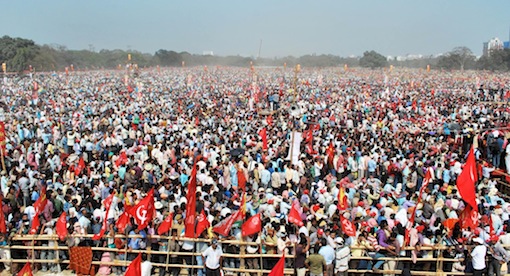
Tapan Sen, general secretary of CITU, in his speech exposed the anti-people nature of the neo-liberal policies being implemented by the union government and emphasised the need for a united struggle against these policies.

In the context of growing number of unorganised sector workers and contractual workers, the 10th state conference emphasised on their problems and issues in detail and outlined the path of future programmes. Special discussions were held on these two aspects.

The delegates in the conference discussed the issue of the contractual labour in detail, especially the growing attack on the labour laws of the country in the name of labour market flexibility. How the neo liberal globalisation policies are impacting the working class people of West Bengal was also discussed in particular. The organisation has decided to observe 12th December 2012 as the demand day for the contractual workers. The workers shall unitedly hold their protest in front of the offices of the department of labour in all the districts. The delegates also pointed out the lethargy of the state government in implementing the social security and welfare programmes initiated by the earlier Left Front government. The delegates exchanged their experiences of the struggle against the terror attacks against the trade union movement by the Trinamool backed hooligans. The delegates expressed confidence of taking on this challenge in the wake of the historic success in the state of the 28th February all India general strike called by the central trade unions. The delegates underlined the importance of consolidating various streams of worker movements in order to achieve the political goals.

The 10th state conference elected the new CITU West Bengal state committee. Shaymal Chakraborty has been re-elected as the president and Dipak Dasgupta has been elected as the secretary.

MASSIVE RALLY
On the concluding day of the conference, on 11th November, the  rally was held at Dumurjala in Howrah. The rally turned out to be a mammoth one. Addressing the rally, former West Bengal chief minister Buddhadeb Bhattacharjee said a desperate situation is prevailing in the state in which farmers are unable to sell produce and industrialists are shying away from investing in the state. “The government failed to attract a single fresh investment. IT majors Wipro and Infosys, who came here during the Left rule, are now thinking of leaving the state,” said Bhattacharjee.

Slamming the government for taking the state towards an industrial disaster in absence of a clear policy, Bhattacharjee referred to how Singur has now become a desert. “Had the car manufacturing factory come up there, about 5000 to 6000 people would have got jobs. Hooghly’s profile would have been different by now, if our plan to bring industry to Singur was not thwarted. At Haldia, one cargo-handling agency was driven out to give way to a company run by a Trinamool Congress MP. This state is gradually moving towards industrial doomsday.”

Bhattacharjee said that the transport workers and the whole transport sector of the state are in a deplorable condition. Most private transport vehicles are lying idle as the agencies are becoming incapable of managing the cost of the business. Transport workers are not getting salaries, pensions, and are compelled to resort to suicides. This is the crude reality of the state where the salaries of ministers in the TMC-led government had gone up from Rs 7000 during the Left Front rule to Rs 27,000 now. And the government is acting as a sleeping beauty, he criticised.

Bhattacharjee also highlighted the farmers’ misery saying they are finding it difficult to sell their crop as the “price they are getting is uneconomical”. Explaining the current labour scenario of the country. Buddhadeb Bhattacharjee sharply criticised the Manmohan Singh government for incessantly taking anti-people decisions that have severely affected the working population of the country.

Wednesday, June 27, 2012

Achievements of Left Front Govt are Ineradicable


EMINENT SPEAKERS OPINE IN KOLKATA

KOLKATA, 20th JUNE: THE achievements of the Left Front government of West Bengal, made during its 34 years long journey, are indelible and no amount of slander can wipe them off. This was the opinion several eminent speakers voiced in a seminar that was organised in Kolkata to commemorate the day of establishment of first Left Front government in West Bengal in June 1977. The seminar, organised by the Left Front, turned into a huge gathering at Nazrul Mancha.

C P Chandrasekhar, an eminent economist, tracked the policy perspective of successive governments in India after independence and identified the alternatives thrown up by the Left led governments. According to him, the Left Front government of West Bengalwas a manifestation of these alternative policies in action, though within structural limitations. Chandrasekhar said the most glaring success of that government was the land reforms through which the agrarian crisis was addressed. Despite initial backwardness and stagnation in the seventies, West Bengal recorded evident successes on social indices including infant mortality, maternal mortality and education. 

N Ram, distinguished journalist, recalled the days of semi-fascist terror in West Bengal in the seventies, and commented, “Many friends in media chose not to know or not to inform.” He said the Left Front assumed office in a terrible situation when the youths were frustrated, education was in a doldrums, and democracy was in peril. The Left Front government then brought about a social security.

Ram emphasised that land reforms not only ensured distributive justice, they actually empowered the peasantry and contributed in the growth of production. Those successes are now in danger under the new regime. Already 61 farmers have committed suicide in West Bengal. Any attempt to reverse the land reforms in the state would invite disasters.

Ram lauded the role of the West Bengal’s Left Front government in poverty reduction, decentralisation of power through panchayats and, on top of everything, the defence of democracy. The civil liberties and democratic rights of the people were safeguarded under the Left Front government. “The initial trends of the new government have sent ominous signals of intolerance,” he said. Ram then added, “Left Front leaders have soberly accepted the defeat in the elections and have reacted with patience but there should be serious watch that the rights of people are not lost.”

Ashok Mitra, the finance minister of first Left Front government, sharply criticised those who talk of so called ‘misrule’ of the said 34 years. Maitra said the ‘misrule’ was that more than 60 per cent of land distribution in the entire country took place in West Bengalalone. The Left Front government ensured the minimum wages for the agricultural workers, established three tier panchayats, and ensured democratic rights of the working people including government employees.

Mitra said it was known to the Left parties and their activists that no fundamental transformation of the society would come through a state government. The aim was to rush whatever relief was possible to the people within the constitutional limitations. Tremendous successes was achieved though there were mistakes. The task of the Left is to overcome those mistakes and go forward with Leftism.

Biman Basu, chairman of Left Front, said that one of the major tasks of the first Left Front government was to restore democracy. In 1977, just after the Left Front government was formed, Comrades Jyoti Basu and Promode Dasgupta gave a call that no political retaliation should be carried out. The government freed all political prisoners.

The first Left Front government fulfilled 28 tasks of the 36 it had promised declared in election manifesto. The new government in the state which assumed office in 2011 has declared that they had already done everything that could have been done in 10 years. Let the people of West Bengal judge such unfounded proclamations.

The seminar was moderated by Professor Shobhanlal Datta Gupta.

On this occasion, the Left Font also brought about a book on the real situation of the state at present. The book, titled West Bengal: Which Way was formally inaugurated by former chief minister Buddhadeb Bhattacharjee.  

Left Front leaders paid floral tributes at the Martyrs’ Column before the programme.

People's Democracy, June 24, 2012